Our CNG knowledge centre
We have gathered the information we use in early project discussions: how stations work, how gas reaches them and how to assess fleet costs. Use these guides to prepare your questions for our team.
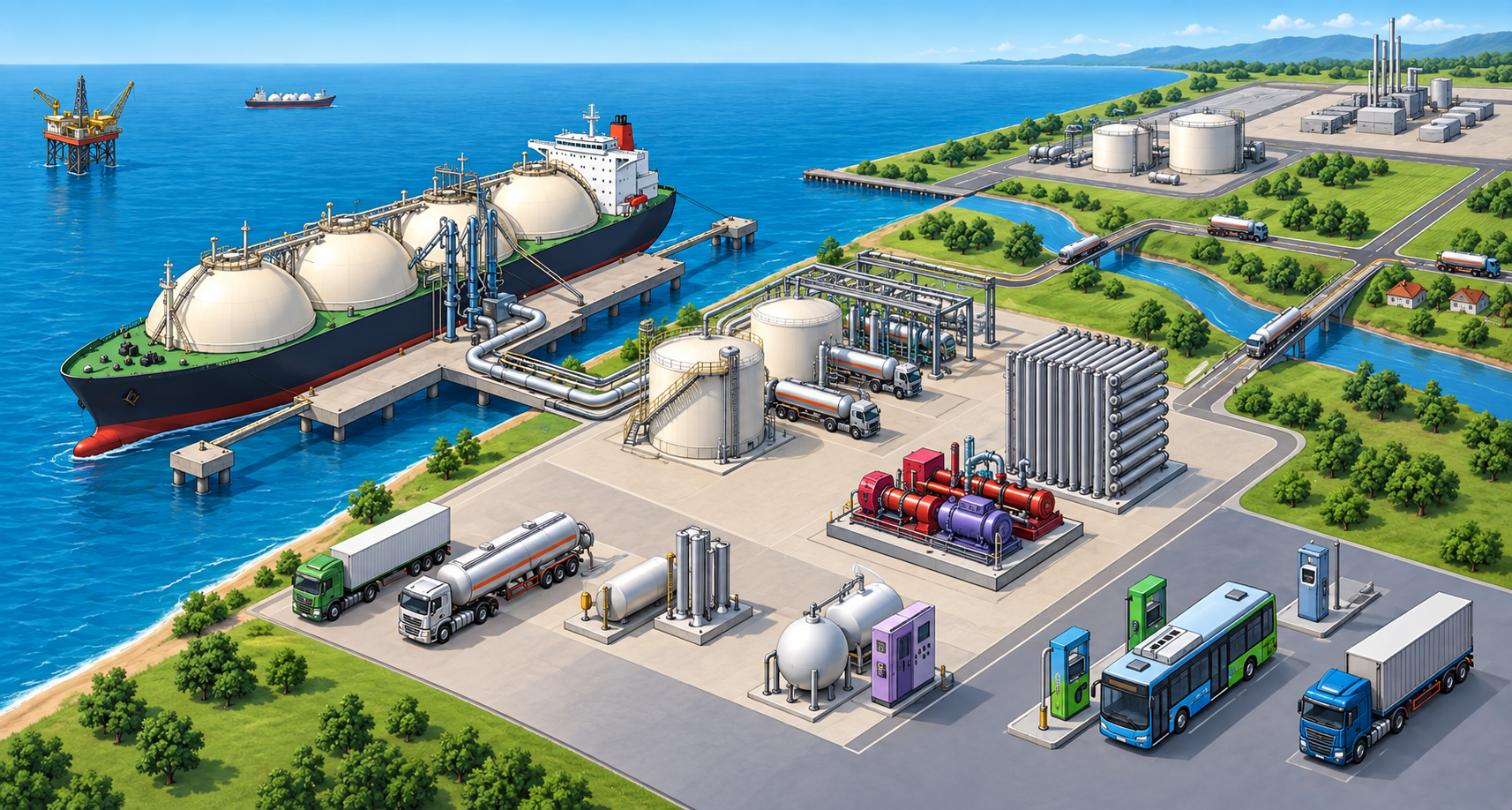
Our gas supply and distribution concept
Explore how we could connect gas supply, storage, transport and customer facilities.
Explore our gas ecosystem ↗What is CNG?
CNG is natural gas stored under pressure for applications including compatible vehicles. It differs from liquefied natural gas (LNG) and liquefied petroleum gas (LPG); equipment and fuel systems are not interchangeable.
AFDC ↗Station models
A CNG facility may combine supply, drying, compression, storage, priority control and dispensing. The required configuration depends on inlet conditions, demand profile, site constraints and the supply method.
Compare specificationsMobile pipeline
Road transport can connect a gas-loading source to a daughter station where a pipeline connection is unavailable. Feasibility depends on distance, payload, loading and unloading time, storage, delivery reliability and delivered cost.
We have allocated US$5m to gas logistics and mobile infrastructure in our plan. We will confirm each station’s supply route, scope and vendor costs through engineering and procurement review.
Fuel economics
A lower unit fuel price alone does not establish savings. Compare measured consumption, mileage, conversion cost, maintenance, downtime and access to supply using consistent units and comparable vehicle duty.
Cost calculatorNigeria’s proposed network
Explore 150 proposed station allocations and their search areas. Deployment spans 2027–2031; the financial view continues to 2033. Filter by state, region or commissioning year.
We have allocated 150 proposed stations to search corridors. We have not yet confirmed actual plots or recorded sites as construction-ready or commissioned. We will release station funding only after the required evidence and approvals are in place.
Interactive mapTechnology & terminology
m³/h expresses volumetric flow at stated reference conditions; kg expresses mass. Litres listed for accumulators describe vessel volume. Do not convert these values without the required gas properties and pressure/temperature basis.
We will confirm the applicable standards and Nigerian approval requirements with our project specialists and the responsible authorities. The references here do not represent a certification of our company or facilities.
Engineering & safety